
New Berkshire CEO Abel quickly signals troubled Kraft Heinz stake could be toast
LivestreamMenuMake ItselectUSAINTL
LivestreamSearch quotes, news & videos
LivestreamWatchlist
SIGN INCreate free accountMarketsBusinessInvestingTechPoliticsVideoWatchlistInvesting ClubPRO
LivestreamMenu
(This is the Warren Buffett Watch newsletter, news and analysis on all things Warren Buffett and Berkshire Hathaway. You can sign up here to receive it every Friday evening in your inbox.)
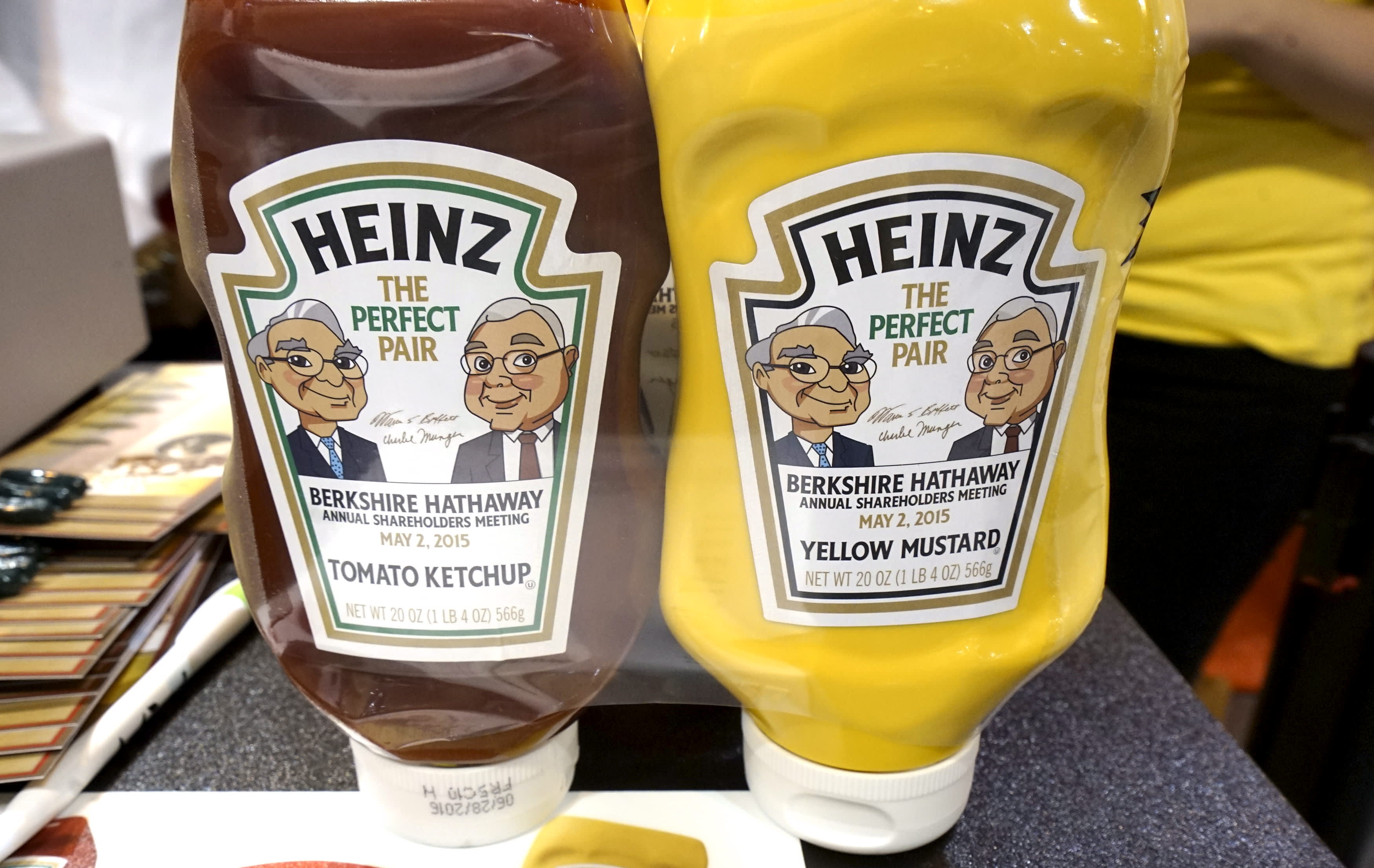
Just a few weeks after Greg Abel formally became the new CEO of Berkshire Hathaway, the company is apparently preparing to sell some or all of the Kraft Heinz shares it acquired in Warren Buffett's 2015 merger deal that has turned out to be a disappointment.
An SEC filing after Tuesday's closing bell by Kraft Heinz says Berkshire, by far its largest shareholder with a 27.5% stake currently worth $7.5 billion, may sell "up to" almost all its shares.
The filing doesn't necessarily mean Berkshire will sell, and it doesn't mean all the shares would be sold at the same time, but it's a strong indication some significant sales are coming.
Berkshire's quarterly 13F portfolio snapshots will probably be how we'll know if the position is shrinking. The report covering Berkshire's current quarter will be released in mid-May.
In Wednesday's trading after the filing, KHC fell about 7% to $21.99, near a six-year low, before rebounding.
It ended at $23.20 Friday, down 1.4% for the week.
For years the company has suffered from underinvestment and strong competition from store-branded alternatives.
In September, it announced a plan to reverse its declines by splitting into two companies, essentially undoing its 2015 merger.
At the time, Buffett criticized the move, telling CNBC, "It certainly didn't turn out to be a brilliant idea to put them together, but I don't think taking it apart will fix it."
Berkshire joined with Brazil's 3G Capital Management to buy H.J. Heinz for $23.3 billion in 2013.
Two years later, in a deal championed by Buffett, Kraft merged with Heinz.
Berkshire's 325 million shares in the combined company were worth around $30 billion in 2016 but have been closer to $10 billion over the past six years.
In his 2015 letter to shareholders, Buffett wrote the shares cost Berkshire $9.8 billion, so right now it has an overall loss of around $2.3 billion.
In a 2019 live CNBC interview (at 17:33 in the clip) with Becky Quick, Buffett had some regrets about Berkshire's role in the Kraft Heinz merger, saying he had "overpaid" for a good company.
(A few months later, he elaborated on that point at the shareholders meeting. The clip and transcript are in Highlights from CNBC's Buffett Archive below.)
CNBC.com quotes Morningstar analyst Greggory Warren telling clients, "We ... view the timing of this sale as being reflective of Abel's desire to clean up and pare down the investment portfolio early in his tenure."
Cutting back on the portfolio will put more cash in the company's already enormous pile of more than $350 billion as of the end of September, potentially putting more pressure on Abel to decide what to do with it amid calls from some shareholders for a dividend.
Some links may require a subscription:
Warren Buffett admits Berkshire Hathaway paid too much for Kraft in its merger with Heinz, citing the growing pricing power of retailers over brands.
In his explanation he highlights one of the most important lessons he learned from Charlie Munger: you can make any transaction into a bad deal by paying too much, but you can't guarantee a good deal by paying too little.
CAROL LOOMIS: To what extent do the changing dynamics in the consumer food market change your view on the long-term potential for Kraft Heinz?
WARREN BUFFETT: Yeah, actually, what I said was, we paid too much for Heinz — I mean Kraft — I'm sorry — the Heinz part of the transaction, when we originally owned about half of Heinz, we paid an appropriate price there. And we actually did well. We had some preferred redeemed and so on.
We paid too much money for Kraft. To some extent, our own actions had driven up the prices.
Now, Kraft Heinz, the profits of that business, 6 billion — we'll say very, very, very roughly — I'm not projecting, I'm not making forecasts — but 6 billion pretax on 7 billion of tangible assets is a wonderful business.
But you can pay too much for a wonderful business.
We bought See's Candy. And we made a great purchase, as it turned out. And we could've paid more. But there's some price at which we could've bought even See's Candy, and it wouldn't have worked.
So, the business does not know how much you paid for it.
I mean, it's going to earn based on its fundamentals. And we paid too much for the Kraft side of Kraft Heinz.
Additionally, the profitability has basically been improved in those operations over the way they were operating before.
But you're quite correct that Amazon itself has become a brand. Kirkland, at Costco, is a $39 billion brand. All of Kraft Heinz is $26 billion. And it's been around for — on the Heinz side — it's been around for 150 years.
And it's been advertised — billions and billions and billions of dollars, in terms of their products. And they go through tens of thousands of outlets.
And here's somebody like Costco, establishes a brand called Kirkland. And it's doing 39 billion, more than virtually any food company. And that brand moves from product to product, which is terrific, if a brand travels.
I mean, Coca Cola moves it from Coke to Cherry Coke and Coke Zero and so on.
But to have a brand that can really move — and Kirkland does more business than Coca Cola does. And Kirkland operates through 775 or so stores. They call them warehouses at Costco. And Coca Cola is through millions of distribution outlets.
So, brands — the retailer and the brands have always struggled as to who gets the upper hand in moving a product to the consumers.
And there's no question, in my mind, that the position of the retailer, relative to the brands, which varies enormously around the world. In different countries, you've had 35 percent, even, maybe 40 percent, be private-label brands in soft drinks. And it's never gotten anywhere close to that in the United States. So, it varies a lot.
But basically, retailers — certain retailers — the retail system — has gained some power. And particularly in the case of Amazon and Walmart and their reaction to it, and Costco — and Aldi and some others I can name — has gained in power relative to brands.
Kraft Heinz is still doing very well, operationally. But we paid too much. If we paid 50 billion, you know, it would've been a different business. It'd still be earning the same amount.
You can turn any investment into a bad deal by paying too much. What you can't do is turn any investment into a good deal by paying little, which is sort of how I started out in this world.
But the idea of buying the cigar butts that are declining or poor businesses for a bargain price is not something that we try to do anymore. We try to buy good businesses at a decent price. And we made a mistake on the Kraft part of Kraft Heinz.
BRK.A stock price: $720,932.19
BRK.B stock price: $478.97
BRK.B P/E (TTM): 15.32
Berkshire market capitalization: $1,034,594,411,899
Berkshire Cash as of September 30: $381.7 billion (Up 10.9% from June 30)
Excluding Rail Cash and Subtracting T-Bills Payable: $354.3 billion (Up 4.3% from June 30)
No Berkshire stock repurchases since May 2024.
(All figures are as of the date of publication, unless otherwise indicated)
Berkshire's top holdings of disclosed publicly traded stocks in the U.S. and Japan, by market value, based on the latest closing prices.
Holdings are as of September 30, 2025, as reported in Berkshire Hathaway's 13F filing on November 14, 2025, except for:
The full list of holdings and current market values is available from CNBC.com's Berkshire Hathaway Portfolio Tracker.
Please send any questions or comments about the newsletter to me at [email protected]. (Sorry, but we don't forward questions or comments to Buffett himself.)
If you aren't already subscribed to this newsletter, you can sign up here.
Also, Buffett's annual letters to shareholders are highly recommended reading. There are collected here on Berkshire's website.
-- Alex Crippen, Editor, Warren Buffett Watch
Buffett’s pledge to give away 99% of his wealth could eventually test Berkshire’s shield against activistsYun Li
Warren Buffett on parenting, horse betting and why he stopped talking politicsAlex Crippen
Warren Buffett was still searching for that elephant to buy in his final months as Berkshire CEOYun LiRead MoreSubscribe to CNBC PROSubscribe to Investing ClubLicensing & ReprintsCNBC CouncilsJoin the CNBC PanelDigital ProductsNews ReleasesClosed CaptioningCorrectionsAbout CNBCInternshipsSite MapCareersHelpContactNews Tips
Got a confidential news tip? We want to hear from you.
Sign up for free newsletters and get more CNBC delivered to your inbox
Get this delivered to your inbox, and more info about our products and services.
© 2026 Versant Media, LLC. All Rights Reserved. A Versant Media Company.
Data is a real-time snapshot *Data is delayed at least 15 minutes. Global Business and Financial News, Stock Quotes, and Market Data and Analysis.
Data also provided by
Recent
News
Newsletter
Subscribe to our mailing list to get the new updates!

Subscribe our newsletter to stay updated
Most
Reviews
Markets
Finance
- Mon, 19 Jan 2026
Combating disinformation must not be confused with censorship
Markets
- Tue, 20 Jan 2026
Selling America is a ‘dangerous bet,’ UBS CEO warns as markets panic
Finance
- Sun, 18 Jan 2026